


Over the last few years, compliance programs have expanded at a breakneck pace. This rapid growth has fostered a dangerous sense of security, creating a "compliance mirage" where sheer volume is mistaken for effectiveness. We assume risks are under control, but most frameworks are merely layers of incremental additions rather than a cohesive, singular strategy.
On the ground, this means foundational functions like conflict of interest disclosures and whistleblowing reports exist in isolation. This fragmented architecture is a direct byproduct of how compliance systems have evolved, leaving high-stakes information scattered across the business.
The consequences are practical, not just theoretical. A declared conflict of interest can sit dormant in a database even when a related report surfaces months later. Without cross-referencing, a high-priority alert is investigated in a vacuum, stripped of the context already sitting elsewhere in the company.
This operational gap creates massive blind spots. For compliance teams, the challenge is rarely a lack of data; it is a failure of connectivity. This disconnect is exactly what quietly drives up organizational exposure.Can you truly manage risk when the information defining it remains siloed?
Conflicts of Interest: Still a Misunderstood Risk
The Trap of the "Check-Box" Approach
In many organizations, conflicts of interest are still treated as a static disclosure exercise. Situations are identified, documented, and promptly archived. While this might tick a regulatory box, it relegates a dynamic risk factor to the bottom of a filing cabinet. It is a process that fulfills the letter of the law while missing the point of risk management entirely.
A conflict of interest is far more than a line on a form; it is a live, evolving risk. It quietly skews business relationships, biases decision-making, and undermines the integrity of internal processes.Whether it is a personal connection influencing a supplier selection, overlapping roles, or participating in negotiations where an indirect interest exists, the result is the same. These are not just HR headaches; they are operational vulnerabilities.

An Underestimated Risk Factor
Taken individually, these situations may seem manageable. The danger arises when they are neither analyzed in context nor monitored over time. Without that oversight, a simple conflict can easily mature into a proven case of fraud or corruption. The data backs this up: conflicts of interest are among the most common red flags in financial crime, appearing in 22% of cases analyzed by the ACFE in 2024.
In most scenarios, alerts related to favoritism or ethical breaches do not emerge from nowhere. They are often part of a broader, pre-existing pattern where a conflict of interest already existed, was perhaps even declared, but was never properly scrutinized.Part of the problem is that defining these risks is notoriously difficult. The concept is subjective, varying wildly across roles, regions, and levels of responsibility. This ambiguity leads to a dangerous gap: some situations go entirely unrecognized, while others are officially declared but never actually followed up on.
The real risk is not a lack of declarations. The true vulnerability lies in how those conflicts are assessed and whether they are ever integrated into a holistic risk posture.
Siloed Systems: The Source of Critical Blind Spots
Separate Processes for Connected Risks
The real challenge in modern compliance is how disclosures connect to the rest of the ecosystem. In most organizations, conflict of interest data and whistleblowing reports live in entirely different worlds.
Declarations are typically collected via dedicated tools or annual campaigns. Meanwhile, reports flow through separate whistleblowing hotlines with their own isolated investigation protocols. This disconnect is particularly glaring when you consider that 43% of fraud cases are detected through internal reporting channels.
This separation often stems from legacy organizational logic. It creates a level of fragmentation that teams struggle to bridge. The result is a major operational gap: a declared conflict of interest might never be factored into the analysis of a high-priority alert. This is not a failure of diligence; it is a structural limitation. True risk management requires a broader perspective to enable better case qualification and earlier detection.
What Siloed Systems Prevent You from Seeing
A Fragmented View of Risk
The limitations of siloed systems have tangible, high-stakes consequences. When conflicts and alerts are handled in isolation, reconstructing a full picture becomes nearly impossible. The information exists, but because it remains scattered, leadership makes decisions based on a partial, skewed view.
This environment allows "weak signals" to slip through the cracks. A previously disclosed third-party relationship or a specific history of declarations might never be flagged during a new investigation. An isolated alert may appear minor on its own, when it is actually a single thread in a much larger, more dangerous pattern.

Incomplete Analysis, Limited Insight
Fragmentation undermines the quality of every investigation. Compliance teams may be diligent, but if the data is incomplete, the output is flawed. This leads to underestimated risks, missed recurring patterns, and cases being closed without anyone truly grasping their implications.
Beyond individual files, your ability to identify systemic trends is compromised. Without connecting these data points, it is difficult to spot emerging threats or adjust compliance programs to meet new challenges. Siloed systems do more than hinder specific cases; they weaken an organization’s fundamental ability to interpret its own risk signals.
A Regulatory Landscape That Requires More Than Processes
Beyond the Compliance Checklist
Siloed systems are more than an internal headache; they are a significant liability in an increasingly aggressive regulatory climate. Modern regulators are looking well beyond the "paper" implementation of formal processes.
Whether governed by Sapin II, its recent evolutions, or global standards, the core expectations are shifting toward traceability, consistency, and impartial handling.
Meeting these standards requires seamless continuity. It is no longer enough to simply have reporting channels in place. Organizations must prove that relevant information is effectively considered at every stage of the compliance lifecycle.
When systems operate in silos, this continuity is impossible. Vital information sits in one database while the team that needs it works in another. This shifts the conversation toward a much more concrete definition of effectiveness: can you demonstrate that your processes actually work to identify and mitigate risk in real time?
What a Unified Approach Changes in Practice
Moving Beyond Data Collection to Strategic Insight
Forward-thinking organizations are moving away from legacy limitations by breaking down silos and finally connecting their compliance data. The goal is not more tools, but a complete, actionable understanding of every risk. This requires bringing data from disparate sources into a single, "single source of truth" framework.
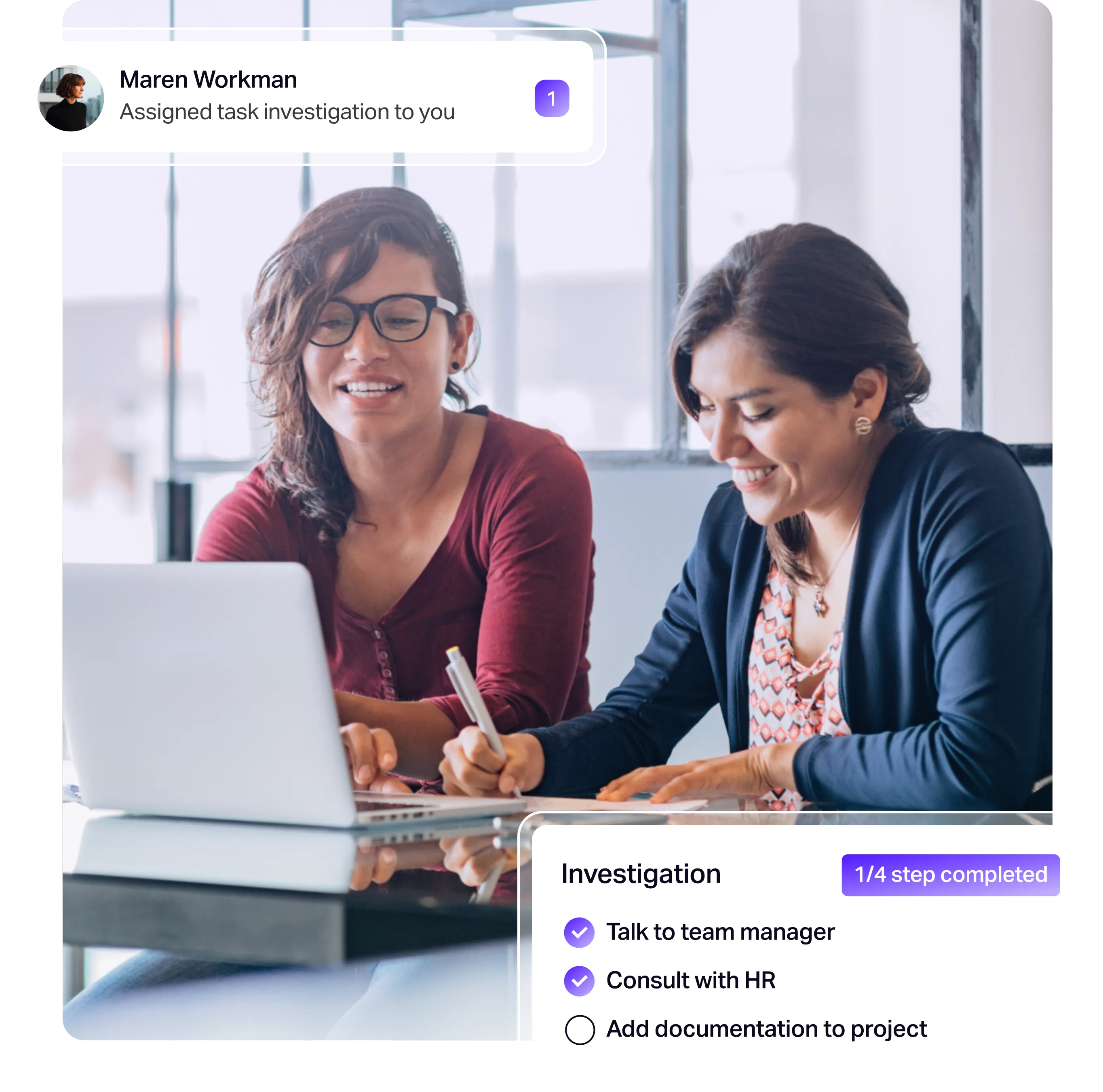
A unified approach centralizes case management at the source. Conflict of interest disclosures, whistleblowing reports, and investigations no longer exist in isolation; they inhabit the same environment.
This integration fundamentally enriches the analysis. An incoming alert can be instantly cross-referenced against existing disclosures, and a previous declaration can be re-evaluated the moment new elements emerge. It allows teams to spot the "red flags" that remain hidden in fragmented systems.
This is the core philosophy behind Whispli. Our platform enables organizations to manage disclosures, reports, and investigations within a single, seamless ecosystem.
Information is no longer treated as an isolated event. A disclosure feeds directly into a case file, ensuring vital context is available at every stage. Compliance teams gain a continuous, bird’s-eye view of risk situations rather than a series of disconnected files. This also dramatically simplifies the day-to-day workflow, allowing teams to collaborate and track cases over time without manual data transfers.
Ultimately, this connectivity improves the entire program's oversight. Data from disclosure campaigns and emerging trends can be leveraged immediately to guide prevention and prioritize the most critical risks.
Moving Toward Connected, Predictive Compliance
The maturity of a compliance program is no longer defined by its sheer scope, but by its ability to analyze and connect information.
Organizations that move beyond siloed approaches stop viewing compliance as a collection of separate tools. They build connected systems capable of turning raw data into strategic insight. The ability to link and leverage information has become the decisive factor in managing risk effectively.
When data points are connected, compliance shifts from being reactive to being truly predictive.






%201.avif)
%201%20(2).avif)
%201%20(1).avif)