

.avif)
Your data is one of your most valuable assets, and it’s also prone to internal and external threats. When it comes to whistleblowing, highly sensitive information, data, and files are exchanged across your organization and sometimes third parties. That’s why making sure we can provide the best security standards to our clients is one of our top priorities.
Through security enhancement features, certifications, and compliance with local security requirements (such as the GDPR in Europe, the Privacy Shield in the United States, or the PIPL in China), our goal is to provide a platform that is safe by design.
.png)
SOC 2 Certified Vendor: Your Data in Good Hands
What does it mean for an organization to select a vendor with a SOC 2 certification?
Being SOC 2 certified means that external auditors assess the extent to which an organization complies with the Five Trust Principles. By selecting a SOC 2-certified vendor, you have proof that your data is protected and that a proven process is in place to ensure excellence in data privacy and security.
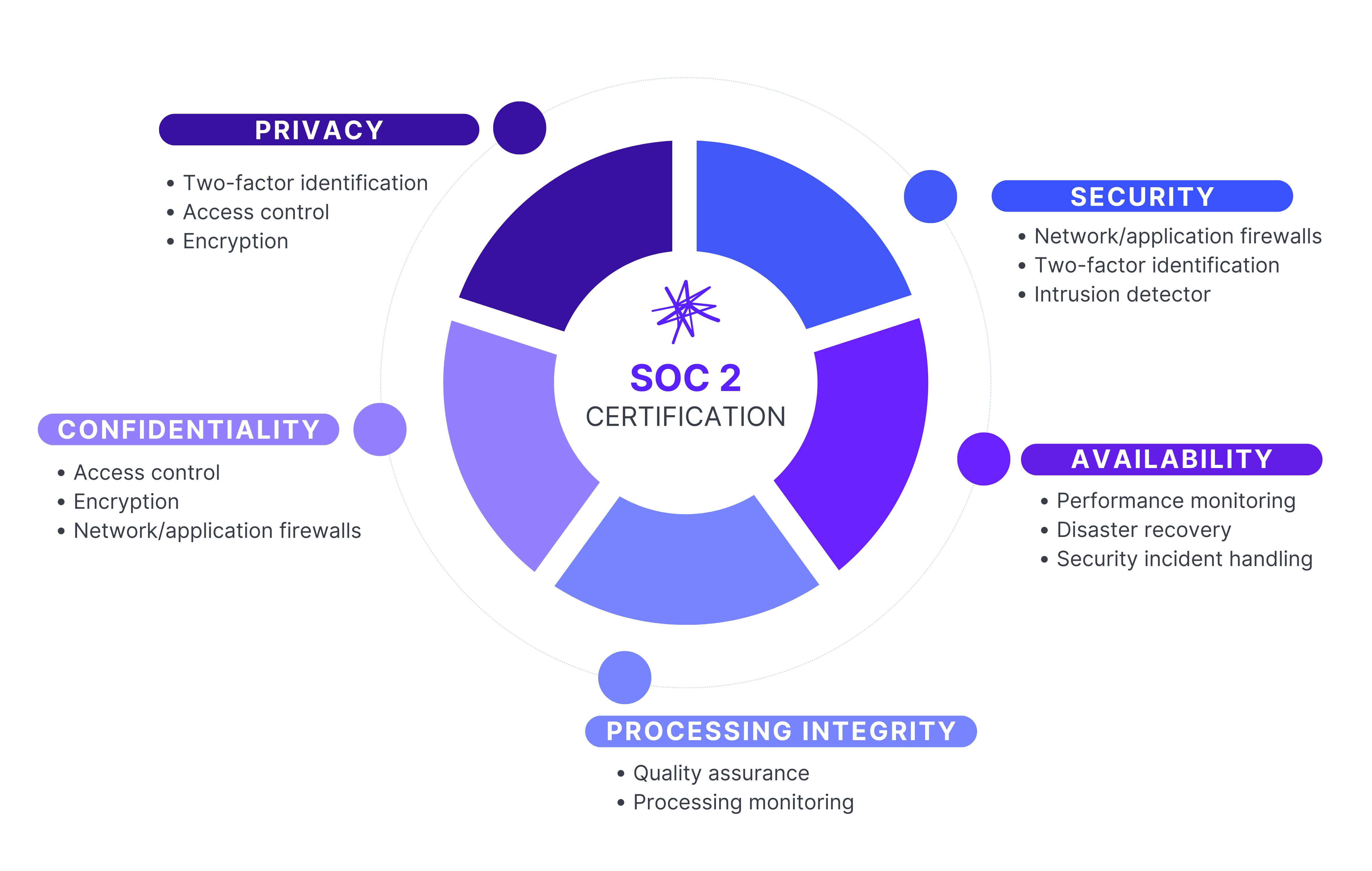
The Five Trust Principles
Protection against unauthorized access (both physical and logical).AvailabilityThe system is available for operation and use as committed or agreed.Processing IntegritySystem processing is complete, valid, accurate, timely, and authorized.ConfidentialityInformation designated as confidential is protected as committed or agreed.PrivacyPersonal information is collected, used, retained, disclosed, and disposed of properly.
Whispli is SOC 2 certified. We are committed to continuous improvement regarding information security in order to offer the most secure whistleblowing system you can find.
What is the SOC 2 Certification?
In the world of information security, SOC 2 has become the gold standard. The security, privacy, and confidentiality practices guaranteed by the SOC 2 framework limit exposure and minimize cyber risks and security breaches.
SOC 1 vs. SOC 2
What type of SOC certification an organization should get depends on the services provided:
- SOC 1: For service organizations that impact or may impact their clients’ financial reporting.
- SOC 2: For service organizations that hold, store, or process information for their clients (but do not directly affect financial statements).
Type 1 vs. Type 2
In order to ensure long-term compliance based on security as a company value, the certification is divided into two types:
- SOC 2 Type 1: Assesses the design of security processes at a specific point in time. It's essentially a test of your compliance program's blueprint.
- SOC 2 Type 2: Assesses how effective those controls are over a period (usually 6 to 12 months). It proves that you don't just have a plan on paper, but that you actually follow it daily.
Why get SOC 2 Certified?
It is important to note that a SOC 2 certification is not mandatory. Whispli voluntarily went through this process because the SOC 2 report is the international benchmark for data security and governance.
Meeting SOC 2 compliance demonstrates a deep commitment to protecting customer data, ensuring they can feel safe about their integrity and privacy. Whispli places the utmost importance on this trust.
Proactive Security: It’s not a tick-the-box exercise for an audit, but a framework to standardize processes, scale operations, and prioritize security as a core company value.
Next Steps: Moving Forward
Our commitment to security doesn’t end with a single certificate. Regular audits are conducted to maintain our level of compliance with AICPA’s principles and standards.
As we move through 2026, we remain confident in our ability to maintain the highest level of data security. Far from a "one and done" exercise, we view security as an ongoing mission to protect the courageous voices that use our platform every day.
Given that SOC 2 focuses so heavily on "Processing Integrity" and "Confidentiality," how does your current internal reporting process ensure that data remains siloed away from those who shouldn't have eyes on it?

Security You Can Stake Your Reputation On
In 2026, data security isn't just a technical requirement—it’s the very foundation of trust. A whistleblowing platform is only as strong as the security that protects its most vulnerable users. By voluntarily achieving SOC 2 certification, Whispli has moved beyond simple compliance to provide a gold-standard guarantee of privacy, availability, and processing integrity.
We don’t just "check boxes"; we build fortresses. When you choose Whispli, you aren't just buying software; you are investing in a safe-by-design environment where sensitive disclosures are shielded by the most rigorous international standards. Whether it’s SOC 2, ISO 27001, or GDPR, our commitment is to ensure that your organization—and the courageous individuals within it—are protected against the threats of today and tomorrow.
Ready to see what the gold standard of secure whistleblowing looks like?






%201.avif)
%201%20(2).avif)
%201%20(1).avif)